DISTANCE
Get closer
Halve the gap between mouth and microphone and your voice is about 6 dB louder, while the room stays put.
Try the distance checkHOW MICROPHONES HEAR
The cheapest upgrade for any microphone is where you put it.
A microphone does not know which sound is your voice and which is the fridge, the street or the echo off a bare wall. Distance and direction decide the mix. Here is how that works, in plain English, with the sources linked.
An independent guide, not a buying guide.
−6 dB per doubling
THE SHORT ANSWER
Two simple rules explain most
of what goes right or wrong with a recording.
DISTANCE
Halve the gap between mouth and microphone and your voice is about 6 dB louder, while the room stays put.
Try the distance checkDIRECTION
A cardioid microphone hears the front best, the sides less and the back least. Point its back at the noise.
See the patternTONE
Very close to a directional microphone, low notes swell. A little extra distance evens it out.
Why it happensA QUICK DISTANCE CHECK
Pick a distance between your mouth and the microphone. The figures use the inverse-square rule of thumb: in an open space, each halving of distance adds about 6 dB.
Real rooms add echoes, so treat these as estimates. The point is the pattern: small moves near the microphone matter far more than the same move farther away.
TWO NUMBERS WORTH KNOWING
One comes from distance, one from direction.
Together they do most of the work.
−6 dB
Double the distance
Sound spreading out in an open space loses about 6 dB of intensity each time the distance doubles. Moving from 12 inches to 6 inches (30 cm to 15 cm) wins that back for your voice, but not for noise across the room.
DISTANCE · INVERSE SQUARE
−6 dB and less behind
Sound arriving from the side
A cardioid microphone is about 6 dB less sensitive to sound from the sides than from the front and, in theory, almost insensitive to sound from directly behind. That helps it separate a voice from the echo of the room.
DIRECTION · CARDIOID PATTERN
Both figures are idealized. Real rooms reflect sound, and real microphones vary with frequency, but the direction of the effect holds.
TRY IT TODAY
Bring the microphone nearer before you turn anything up. Turning up the level raises the room noise along with your voice.
Near the microphone, small leans change the level a lot. Pick a comfortable spot and stay there.
With a directional microphone, turn its back toward the open window, the computer fan or the hum you want less of.
Listen back on headphones. If it sounds boomy, move back a little; if it sounds distant and echoey, move closer.
MICROPHONE FACTS
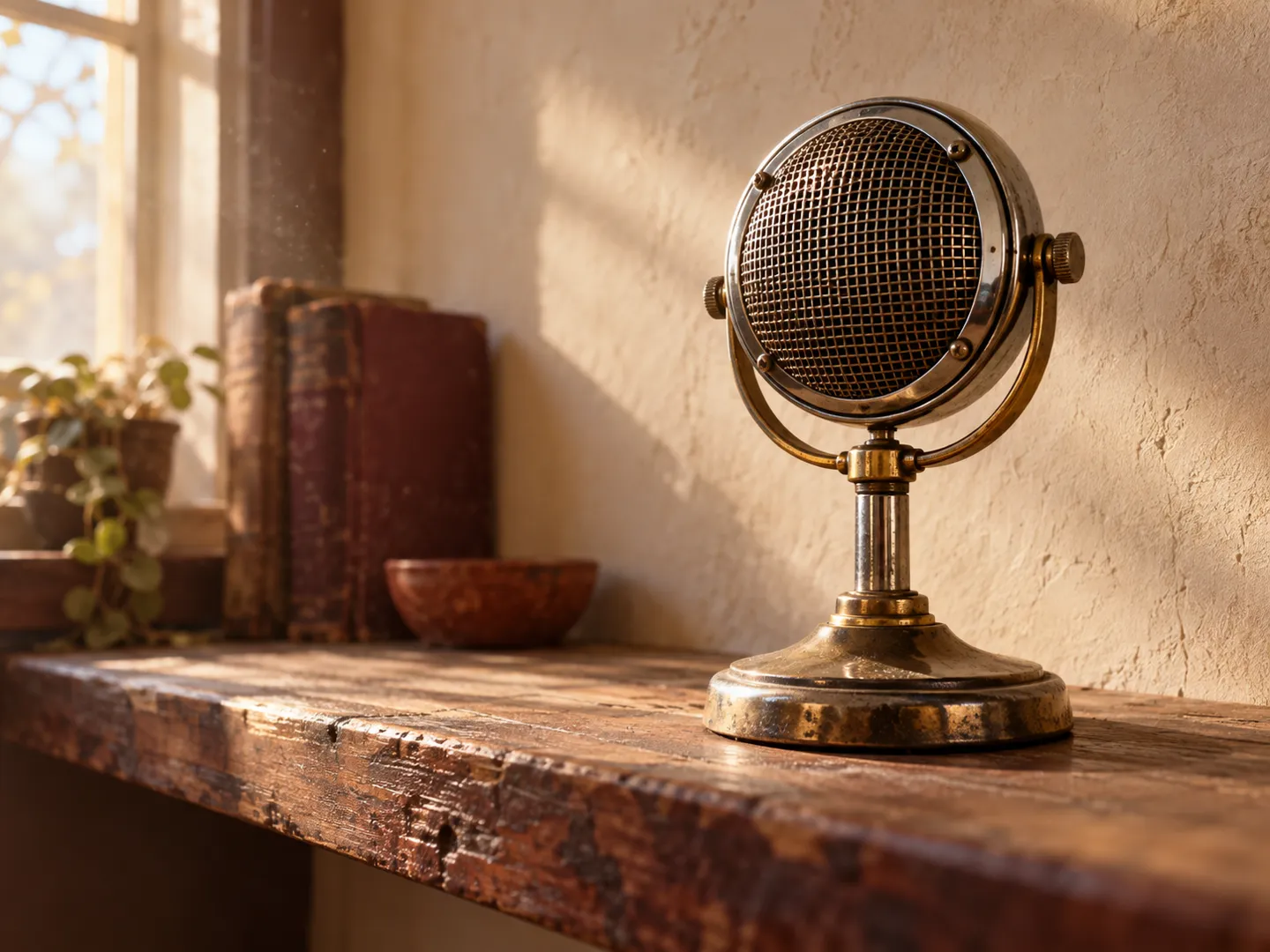
Charles Wheatstone first used the word microphone in 1827. David Edward Hughes revived it for the carbon microphone he demonstrated in 1878.
Hughes chose not to patent his microphone. The Science Museum Group notes he found that light but constant pressure was the only essential, and that later inventors used his work without credit.
James West and Gerhard Sessler filed the patent for the electret microphone at Bell Labs in 1962. West has estimated that more than two billion electret microphones are made each year.
On directional microphones, low frequencies grow as the source moves closer. A 2011 Audio Engineering Society paper calls this proximity effect an undesired boost in low-frequency energy.
Cardioid means heart-shaped. These microphones favor the front, and their main strength is telling direct sound apart from reverberant sound.
QUICK QUESTIONS
Short answers to the questions people ask most.
There is no single right distance, but the physics is simple: in an open space, each time you halve the distance your voice gets about 6 dB louder, while the room stays the same. Closer usually means clearer, until bass build-up and breath noise start to creep in.
Cardioid means heart-shaped. A cardioid microphone is most sensitive to sound from the front, about 6 dB less sensitive at the sides, and in theory almost deaf to sound from directly behind it.
That is the proximity effect: on directional microphones, low frequencies get stronger as the source moves closer. Audio researchers describe it as an undesired boost in low-frequency energy at short distances. Backing off slightly reduces it.
Many small devices use descendants of the electret microphone, for which James West and Gerhard Sessler filed a patent at Bell Labs in 1962. West has estimated that more than two billion electret microphones are made each year.
Several people contributed. The word was first used by Charles Wheatstone in 1827. In 1878 David Edward Hughes demonstrated a carbon microphone and chose not to patent it, so others could build on his work freely.
Sources
A NAME WORTH HEARING
doodlemicrophone.com is part of the DoodleSale portfolio. It isn't in an auction right now, but you can ask about leasing it.